Document Reveals Trump Administration Planned on Separating Migrant Families Soon After Inauguration
New documents reveal anarchy behind Trump'south family unit separation policy
U.Southward. edge regime received inconsistent guidance on how to carve up up migrant families during the Trump assistants'southward "zero tolerance" policy in 2018, with some officials instructing subordinates not to separate children under five from their parents and others not outlining any age exceptions, according to previously undisclosed documents obtained by Congress.
Customs and Border Protection (CBP) agents in fundamental Texas were told not to dissever minors with mental or concrete disabilities and those under 5, while officers in El Paso were instructed to get out one parent with children who were 4 or younger or in poor health and did not speak Spanish, co-ordinate to the documents. A May 2018 memo for border officers in southern California did not include whatsoever exceptions to family unit separations.
The newly disclosed documents were obtained by the Democratic-led House Judiciary Committee and included in a 551-page report released Thursday detailing the findings of a about two-yr-long committee investigation. The documents provide additional testify about the faulty implementation of the Trump administration'due south zero tolerance policy, which was eventually reversed subsequently judicial intervention and massive public outcry.
"The Commission's report makes articulate that [the] Trump Assistants was willing to go to extreme lengths, including ripping young children and children with disabilities from the arms of their parents, to stop migrants fleeing violence from seeking protection in the United states," Chairman Jerry Nadler said in a joint argument with Representative Zoe Lofgren, the chairwoman of the subcommittee on immigration.
Thursday'due south report also expands on previous documentation that career health officials issued several warnings in 2017 about an uptick in transfers of unaccompanied migrant minors who had been separated from their parents at the U.S.-Mexico border.
During the full-scale zilch tolerance policy in the spring of 2018, U.Due south. border officials separated more than ii,800 families, sending parents to detention facilities for adults and transferring their children to the Office of Refugee Resettlement, a division of the Department of Health and Human Services (HHS) tasked with caring for undocumented minors who are classified as unaccompanied.
However, the Trump administration implemented a pilot program in El Paso for approximately five months in 2017 before expanding the goose egg tolerance policy, which was designed to deter unauthorized migration, across the U.S.-United mexican states border in the spring of 2018. Through the court example that brought an end to large-calibration family unit separations, the government revealed that it separated more than 1,000 families during this initial phase of separations.
In early November of 2017, Commander Jonathan White, a career public health official at HHS, emailed Scott Lloyd, then the head of the U.S. refugee agency, alert him that, "Nosotros had a shortage last night of beds for babies."
"Overall, baby placements seem to be climbing over recent weeks, and we call back that's due to more separations from mothers past CBP," White wrote, correctly assuming that the uptick in transfers of young unaccompanied minors stemmed from a family separation plan his bureau was unaware of at the fourth dimension.
Six days later, White emailed Kevin McAleenan, and then the commissioner of CBP, which was carrying out the separations. Providing internal information, White again warned of a "significant increase" in transfers of separated children.
McAleeenan did not get back to White by e-mail until the next month, telling him then, "You should have seen a alter the past 10 days or so." McAleenan also pledged to coordinate "in accelerate of any hereafter plans."
On June 2, 2018, at the acme of the zilch tolerance policy, Gregory Davis, the planning and logistics director of the federal program for unaccompanied migrant children, emailed Lloyd, the refugee agency director, telling him that they would be receiving a "agglomeration of tender historic period girls." Davis noted concerns most insufficient bed space for these minors, as not all shelters could house "tender age" children.
"This is caused by the policy decision to split kids from families as a deterrent," Davis wrote, echoing White'southward warnings from the year before.
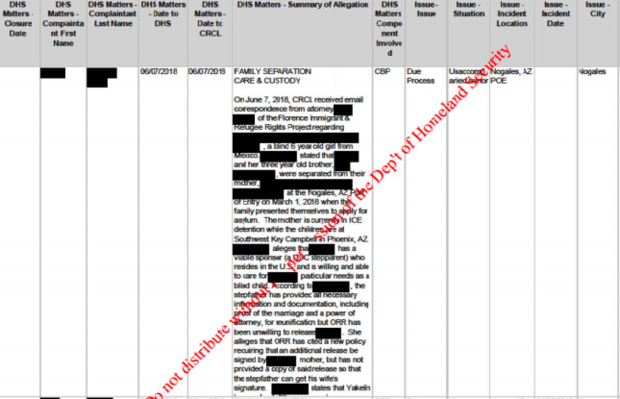
The documents released by the House Judiciary Committee also include spreadsheets listing hundreds of complaints made to the DHS Role for Civil Rights and Ceremonious Liberties nigh family separations before the full implementation of zero tolerance.
One instance centered on a 3-year-sometime boy and his blind half dozen-year-old sister who were separated from their mother, who was and then detained at an Immigration and Customs Enforcement facility in Arizona. The children were said to take a stepfather who was a U.S. citizen and could serve as their sponsor. A summary of the complaint said the stepfather was "willing and able to care for [redacted'southward] particular needs as a bullheaded child" and had "provided all necessary information and documentation, including proof of the marriage and power of attorney."
But the refugee office declined to release them, with an attorney representing the family unit maxim the agency cited a new policy requiring the mother to sign an additional release form.
"She alleges … [that ORR] has non provided a copy of said release so that the stepfather tin can become his married woman'due south signature," the summary said.
Most of the families separated during the full-calibration nothing tolerance policy were eventually reunited afterward cluttered courtroom-mandated reunification efforts stemming from poor interagency planning and data sharing. Parents who were deported without their children during this phase were located and some chose to take their children brought back to Central America, while others immune them to stay in the U.Due south.
Even so, advocates are yet looking for 545 parents who were separated from their children as part of the more than one,000 separations that occurred in 2017 and early 2018. If plant, the parents could be eligible to be reunited with their children.
Representatives for DHS and the Administration for Children and Families, which oversees the U.Due south. refugee agency, did not immediately answer to requests to comment on Th'south report.
Camilo Montoya-Galvez

Source: https://www.cbsnews.com/news/family-separation-policy-trump-administration-documents-immigration/

Post a Comment for "Document Reveals Trump Administration Planned on Separating Migrant Families Soon After Inauguration"