How Can a Rack and Pinion Be Useful
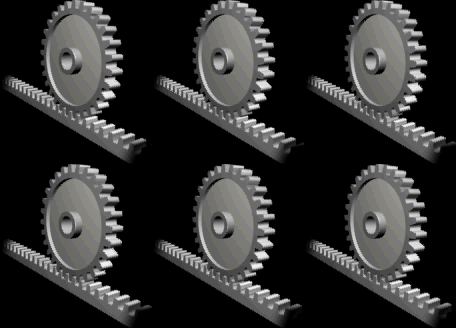
Rack and pinion animation
A rack and pinion is a type of linear actuator that comprises a circular gear (the pinion) engaging a linear gear (the rack), which operate to translate rotational motility into linear movement. Driving the pinion into rotation causes the rack to be driven linearly. Driving the rack linearly will cause the pinion to exist driven into a rotation. A rack and pinion bulldoze can employ both straight and helical gears. Though some advise Helical gears are noted for "quieter" functioning, there is no science to support this theory. Helical racks while being more affordable, have proven to increase side torque on the datums, increasing operating temperature leading to premature wear. Straight racks crave a lower driving forcefulness and offer increased torque and speed per percentage of gear ratio which allows lower operating temperature and lessens viscal friction and free energy utilize. The maximum forcefulness that can be transmitted in a rack and pinion mechanism is adamant past the tooth pitch and the size of the pinion likewise as the gear ratio..
For case, in a rack railway, the rotation of a pinion mounted on a locomotive or a railroad motorcar engages a rack placed between the rails and helps to movement the train upwardly a steep gradient.
For every pair of conjugate involute contour, there is a basic rack. This basic rack is the profile of the conjugate gear of infinite pitch radius (i.e. a toothed directly edge).[1]
A generating rack is a rack outline used to indicate tooth details and dimensions for the design of a generating tool, such as a hob or a gear shaper cutter.[1]
Applications [edit]
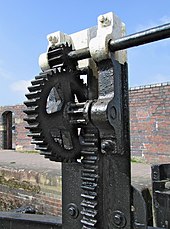
Rack and pinion combinations are frequently used every bit part of a uncomplicated linear actuator, where the rotation of a shaft powered by mitt or past a motor is converted to linear motion.
The rack carries the total load of the actuator directly and then the driving pinion is usually small, so that the gear ratio reduces the torque required. This force, thus torque, may still be substantial and then it is mutual for there to exist a reduction gear immediately before this past either a gear or worm gear reduction. Rack gears have a higher ratio, thus crave a greater driving torque, than spiral actuators.
Stairlifts [edit]
Most stairlifts today operate using the rack and pinion organization.[ citation needed ]
Steering [edit]

Rack steering in an automobile
A rack and pinion is commonly constitute in the steering mechanism of cars or other wheeled, steered vehicles. Rack and pinion provides less mechanical advantage than other mechanisms such as recirculating ball, but less backlash and greater feedback, or steering "feel". The machinery may be power-assisted, usually by hydraulic or electrical means.
The use of a variable rack (even so using a normal pinion) was invented by Arthur Ernest Bishop[2] in the 1970s, so equally to improve vehicle response and steering "feel", specially at high speeds. He also created a low price press forging process to industry the racks, eliminating the demand to auto the gear teeth.
Rack railways [edit]

Rack railways are mountain railways that apply a rack built into the center of the runway and a pinion on their locomotives. This allows them to work on steep gradients, upwards to 45 degrees, every bit opposed to conventional railways which rely on friction alone for locomotion. Additionally, the rack and pinion addition provides these trains with controlled brakes, and reduces the effects of snow or ice on the track.
Actuators [edit]

Pneumatic rack and pinion actuators
A rack and pinion with two racks and one pinion is used in actuators. An instance is pneumatic rack and pinion actuators that can be used to command valves in pipeline transport. The actuators in the picture on the right are used to control the valves of large water pipeline. In the pinnacle actuator, a gray control signal line tin can be seen connecting to a solenoid valve (the small black box attached to the back of the top actuator), which is used as the airplane pilot for the actuator. The solenoid valve controls the air pressure coming from the input air line (the small green tube). The output air from the solenoid valve is fed to the chamber in the middle of the actuator, increasing the pressure. The force per unit area in the actuator's sleeping accommodation pushes the pistons abroad. While the pistons are moving apart from each other, the fastened racks are also moved forth the pistons in the reverse directions of the two racks. The 2 racks are meshed to a pinion at the direct opposite teeth of the pinion. When the two racks move, the pinion is turned, causing the fastened principal valve of the water pipe to turn.[3] [4]
Arcuate rack [edit]
A rack gear that is curved is chosen an arcuate rack.[5] The term appears in many patent applications.[ which? ]
History [edit]
The Chinese Wu Pei Chih (1621) described Ottoman Turkish muskets that used a rack-and-pinion machinery, which was not known to have been used in any European or Chinese firearms at the time.[six]
See also [edit]
- List of gear classification
- Auto element
- Pitman arm
- Sprocket
- Steep grade railway
References [edit]
 | Wikimedia Commons has media related to Rack gears. |
- ^ a b Gear Nomenclature, Definition of Terms with Symbols. American Gear Manufacturers Association. 2005. p. 72. ISBNane-55589-846-7. OCLC 65562739. ANSI/AGMA 1012-G05.
- ^ "Rack and pinion variable ratio steering gear". Google Patent Search. Retrieved 2007-03-22 .
- ^ "The Function of Rack and Pinion Actuators in On-Off & Modulating Controls". Valve Mag. Valve Manufacturers Association (Spring 2010).
- ^ "Automax SuperNova Series Pneumatic Rack & Pinion Actuators" (PDF). Flowserve Corporation. Retrieved seven July 2014.
- ^ Phillips, Jack (2003). General Spatial Involute Gearing. Berlin, Heidelberg: Springer Berlin Heidelberg. ISBN3662053020.
- ^ Needham, Joseph (1986), Science & Civilisation in Prc, vol. V:7: The Gunpowder Epic, Cambridge University Printing, p. 446, ISBN0-521-30358-iii
Source: https://en.wikipedia.org/wiki/Rack_and_pinion

Post a Comment for "How Can a Rack and Pinion Be Useful"